
EXHIBITIONS
Current Exhibitions
Our current exhibitions we are constantly rotating throughout the year.
Permanent Exhibitions
Our exhibitions which are constant installments in our museum.
Past Exhibitions
A list of our past exhibitions at the African American Museum Dallas.
AAMD EXHIBITION SCHEDULE
2026
Current Exhibitions

People Who Make The World Go ‘Round:
The Legacy Of Sepia Magazine
May 12 – August 11, 2026
African American Museum, Dallas
People Who Make the World Go ‘Round: The Legacy of Sepia Magazine, on view May 12 through Aug. 11, 2026. Spotlighting some of the 20th century’s most influential Black icons – from Aretha Franklin and Ray Charles to Maya Angelou, Dr. Martin Luther King Jr. and Thurgood Marshall – the exhibition draws from the Museum’s renowned Sepia photographic archive of more than 40,000 images.
Organized thematically, the exhibition explores portraiture, fashion, global politics and the many individuals who helped shape American culture and society. Other powerful highlights include images of Richard Pryor, Louis Armstrong at the State Fair of Texas, Michael Jackson, Berry Gordon, Malcolm X and Fidel Castro, Sidney Poitier, Gordon Parks, Josephine Baker, Nina Simone, and Roberta Flack with John Leonnon, Yoko Ono and David Bowie.
With images of key figures in Black life from the mid-twentieth century as well as examples of the magazine’s content and stories, People Who Make the World Go ‘Round revisits the heyday of print photojournalism and provides historical context for the popularity of digital media representations today.
The exhibition is curated by Dr. Cheryl Finley, director of the Atlanta University Center Art History + Curatorial Studies Collective and distinguished visiting professor of Art History at Spelman College.
This exhibition is presented by ExhibitsUSA (EUSA) a traveling exhibition program managed Mid-by Mid-America Arts Alliance.
Permanent Exhibitions
Temporarily closed due to the Mandela Exhibition schedule
FACING THE RISING SUN: FREEDMAN’S CEMETERY
Facing The Rising Sun presents the remnants of a once-thriving North Dallas Community. Facing the Rising Sun contains photographs, found objects, and historical documents that provide an insight into a community called Freedman’s Town and later known as short North Dallas and now known as Uptown. Interactive video kiosks allow visitors to see and hear from the people who knew Freedman’s Town first-hand.
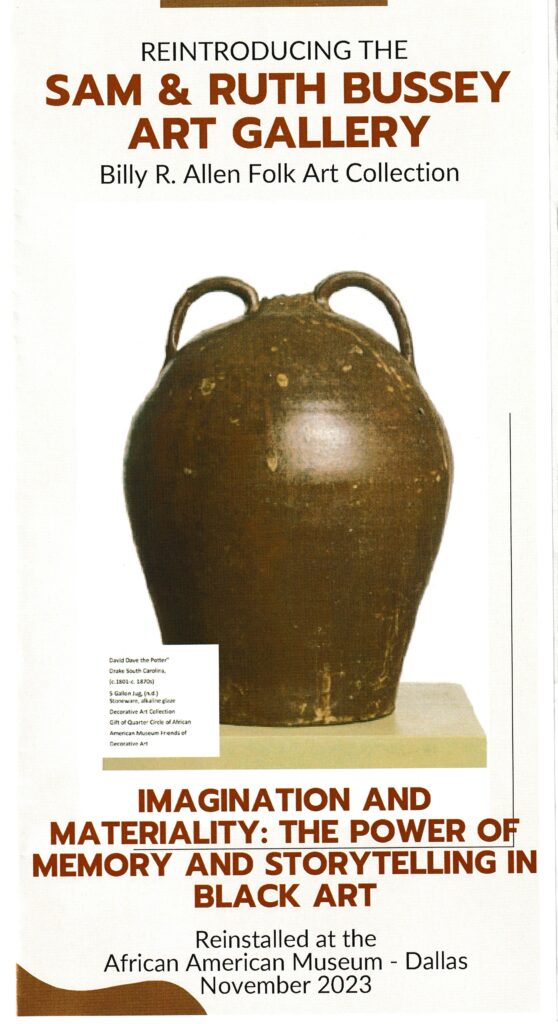
The Sam & Ruth Bussey Art Gallery | Imagination and Materiality: The Power of Memory and Storytelling in Black Art
Reinstalled November 2023
The AAM, Dallas has one of the largest collections of African American folk art in the country. The Billy R. Allen Folk Art Collection, named for a founding board member, has grown to include more than 500 objects. Dr. Warren and Sylvia Lowe of Lafayette, Louisiana, Sally Griffiths and Dr. Bobby Alexander of Dallas, Texas have been major contributors. Pieces from the collection are rotated, twice each year, in the Sam and Ruth Bussey Gallery. Artists include Clementine Hunter, Mose Tolliver, Reverend Johnnie Swearingen, David Butler, Sister Gertrude Morgan, and Isaac Smith to name a few.
The Decorative Arts Collection consists of objects as early as the late 18th century. Some items are an 1824 coverlet; five pieces crafted between 1840-1850 by the legendary North Carolina furniture maker, Thomas Day (1820-1860); an 1888 crazy quilt; an 1830 slave made desk from San Augustine, Texas; and ceramics by Carroll Harris Simms, Co-founder of the Texas Southern University Art Department and Sandy Besser African Basket Collection. Also included is a silver teaspoon made by Peter Bentzon (1783-1850).
Past Exhibits

Protecting Cultural Memory
On view September 17, 2025 – March 2026
Protecting Cultural Memory is a compelling exploration of the Museum’s ongoing commitment to preserving, conserving, and safeguarding the priceless art, artifacts, and archival materials entrusted to its care. Offering visitors a rare behind-the-scenes perspective, the exhibition illuminates the essential work that ensures African American history, creativity, and cultural heritage remain protected for generations to come.
A significant component of the exhibition features objects preserved from the Museum’s Mr. Imagination Fire Exhibition. These works—shaped by the studio fire that once threatened to erase part of the artist’s legacy—provide a powerful lens through which to understand the urgency and impact of timely, skilled, and compassionate conservation. Mr. Imagination (Gregory Warmack), celebrated for transforming found and discarded materials into spiritually resonant sculptures, created art rooted in memory, imagination, and cultural meaning. The fire-touched pieces on view deepen the conversation around preservation, reminding visitors how vulnerable cultural heritage can be—and how essential the Museum’s protective efforts are in ensuring its survival.
Protecting Cultural Memory also highlights both the fragility and resilience of the Museum’s broader collections. Through conservation case studies, restoration narratives, and interpretive displays, visitors will learn how environmental conditions, time, and handling affect preservation—and how the Museum’s conservation practices work to counteract these forces.
The exhibition further elevates the contributions of archivists, conservators, scholars, and community partners whose expertise makes it possible to sustain these cultural touchstones. From repairing works on paper and stabilizing aging textiles to conserving material culture and digitizing vulnerable archives, their collective efforts reflect a broader mission: to honor the past by protecting its physical record.
At a time when the preservation of African American history is more crucial than ever, Protecting Cultural Memory underscores that conservation is not merely a technical practice—it is an act of respect, responsibility, and cultural continuity. Each restored artwork is a memory reclaimed. Each preserved archival box is a chapter safeguarded. Together, they form a living testament to the richness, complexity, and enduring legacy of African American life.

Visible Thoughts The Visual Language of Morris Yanger
On view September 18, 2025 - April 2026
Visible Thoughts: The Visual Language of Morris Yanger celebrates the expressive, deeply intuitive artwork of Morris Yanger, a distinguished Dallas-based artist whose vibrant compositions explore the intersections of memory, identity, and spiritual reflection. Rooted in a lifelong commitment to creative exploration, Yanger’s work translates the unseen—emotion, intuition, and lived experience—into a bold, visual language all his own.
Drawing upon abstraction, symbolism, and rich, layered color palettes, Yanger creates paintings that invite viewers into an interior world made visible. His canvases pulse with movement and emotion, offering glimpses into the artist’s processing of the world around him: the weight of history, the complexity of human relationships, and the quiet revelations that emerge through self-examination. Every stroke carries intention; every composition encourages viewers to look deeper, feel more fully, and engage with questions that lie beneath the surface.
This exhibition presents a dynamic selection of works spanning key periods of Yanger’s artistic evolution, showcasing his growth from early expressive figurations to the bold, gestural abstractions that define his mature style. Through form, texture, and improvisational mark-making, Yanger builds visual narratives that are at once personal and universal—stories of resilience, curiosity, and the transformative power of art.
Visible Thoughts offers visitors an immersive encounter with the inner landscapes of a contemporary African American artist whose voice continues to shape and influence the Dallas arts community. Yanger’s work stands as a testament to creativity as a form of language, healing, and connection.

Sunday Call to Church: The Art of Clementine Hunter
On view December 5, 2025 – March 6, 2026
